|
In SPhyang Monastery-Alchiplendid
Isolation
Driving past on the nearby Srinagar -Leh highway, you'd never
guess that the cluster of low pagoda r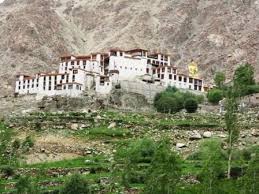 oofed
cubes 3-km across the Indus from Saspol, dwarfed by a
spectacular sweep of pale brown and wine coloured scree, is one
of the most significant historical sites in Asia. Yet the
Chos-khor, or "religious enclave", at Alchi, 70-km west of Leh,
harbours an extraordinary
wealth of ancient wall paintings and wood sculpture,
miraculously preserved for over nine centuries inside five tiny
mud walled temples. oofed
cubes 3-km across the Indus from Saspol, dwarfed by a
spectacular sweep of pale brown and wine coloured scree, is one
of the most significant historical sites in Asia. Yet the
Chos-khor, or "religious enclave", at Alchi, 70-km west of Leh,
harbours an extraordinary
wealth of ancient wall paintings and wood sculpture,
miraculously preserved for over nine centuries inside five tiny
mud walled temples.
A Priceless Himalayan Heritage
Art historians rave about the site because its earliest murals
are the finest surviving examples of a style that flourished in
Kashmir during the "Second Spreading". Barely a handful of the
monasteries founded during this era escaped the Muslim
depredations of the fourteenth century. Of them all, Alchi is
the most impressive, the least remote and the only place where
one doesn't need a special permit to visit. Nestled beside a
bend in the milky blue river Indus, amid some dramatic scenery,
it's also a serene spot and the perfect place to break a long
journey to or from the Ladakhi capital.
The Chos-khor consists of five separate temples, various
residential buildings and a scattering of large Chortens,
surrounded by a mud and stonewall and a curtain of tall poplar
trees. If one is pushed for time, concentrate on the two oldest
buildings, the Du-khang and the Sumtsek, both in the middle of
the enclosure. Entrance tickets are issued by a caretaker lama
fr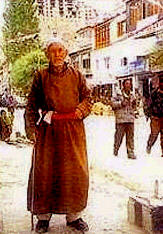 om
nearby Likkir Gompa, who will unlock the doors for the visitors.
To make the most of the paintings vibrant colours, one will need
a strong flashlight; but don't use a camera flash as it will
damage the murals, last restored in the 16th century. om
nearby Likkir Gompa, who will unlock the doors for the visitors.
To make the most of the paintings vibrant colours, one will need
a strong flashlight; but don't use a camera flash as it will
damage the murals, last restored in the 16th century.
The Du-Khang
An inscription records that Alchi's oldest structure, the
Du-Khang, was erected late in the 11th century by Kaldan Shesrab,
a graduate of the now ruined Nyarma Gompa near Tikse, itself
founded by the "Great Translator" Rinchen Zangpo. Approached via
a walled courtyard and a path that runs under a hollow Chorten,
the square temple's wooden doorway is richly carved with
meditating Bodhisattvas.
Once one's eyes adjust to the gloom inside, check out the niche
in the rear wall where Vairocana, the "Buddha Resplendent", is
flanked by the four main Buddha manifestations that appear all
over Alchi's temple walls, always presented in their associated
colours: Akshobya ("Unshakable"; Blue), Ratnasambhava (""Jewel
Born"; Yellow), Amitabha ("Boundless Radiance"; Red) and
Amoghasiddhi ("Unfailing Success"; Green). The other walls are
decorated with six elaborate Mandalas, interspersed with
intricate friezes.
The Sumtsek
Standing to the left of the Du-khang, the Sumtsek is Alchi's
most celebrated temple, and the highest achievement of early
medieval Indian Buddhist art. Its woodcarvings and paintings,
dominated by rich reds and blues, are almost as fresh and
vibrant today as they were 900 years ago, when the squat triple
storeyed structure was built. The resident lama leads visitors
under a delicate wooden façade to the interior of the shrine,
shrouded in a womb like darkness broken only by flickering
butter lamps. Scan the walls with a flashlight and you'll see
why scholars have filled volumes on this chamber alone.
Surrounded by a swirling mass of 'Mandalas', Buddhas, Demi Gods
and sundry other celestials, a colossal statue of Maitreya, the
Buddha-to-come, fills a niche on the ground floor, his head
shielded from sight high in the second storey.
Accompanying him are two equally grand Bodhisattvas, their heads
peering heads peering serenely down through gaps in the ceiling.
Each of these stucco statues wears a figure clinging Dhoti,
adorned with different, meticulously detailed motifs.
Avalokitesvara, the Bodhisattva of compassion, has pilgrimage
sites, court vignettes, palaces and pre-Muslim style Stupas on
his robe, while that of Maitreya is decorated with episodes from
the life of Gautama Buddha. The robe of Manjushri, destroyer of
falsehood, to the right, shows the 84 masters of Tantra, the
Mahasiddhas, adopting complex yogic poses in a maze of bold
square patterns.
Beautiful Frescoes Of Deities
Among exquisite murals, some repaired in the 16th century, is
the famous six-armed green Goddess Prajnaparamita, the
"Perfection of Wisdom" central to Mahayana thought, and closely
associated with Tara. Heavily bejewelled, she sits on a lotus by
Avalokitesvara's gigantic left leg. Amazingly, this, and the
multitude of other images that plaster the interior of the
Sumtsek, resolve, when viewed from the centre of the shrine,
into a harmonious whole.
Other Temples
The Chos-khor's three other temples all date from the 12th and
13th centuries, but are nowhere near as impressive as their
predecessors. Tucked away at the far river end of the enclosure,
the Manjushri La-khang is noteworthy only for its relatively
recent "Thousand Buddha" paintings and gilded four-faced icon of
Manjushri that fills almost the whole temple.
Next door the Lotsawa La-khang, with its central image and mural
of Shakyamuni, is one of a handful of temples dedicated to
Rinchen Zangpo, the "Great Translator". Whose missionary work
inspired the foundation of Alchi; his small droopy-eared image
sits on the right of Shakyamuni. The Lama may need to be cajoled
into unlocking the La-khang Soma, the small square shrine south
of the Sumtsek, which is decorated with three large Mandalas and
various figures including an accomplished Yab Yum: the Tantric
image of the copulating deities symbolizes the union of
opposites on a material and spiritual level.
HOW TO GET THERE
Road: One bus per day leaves Leh for Alchi in summer, taking
three hours to cover the 70-km and returning early the next day.
Other buses heading in that direction leave Leh at 6.30 am (for
Kargil) and 9.00 am (for Dah-Hanoo) - one can catch one of these
get off at Saspol, and walk the remaining 2.5-km via the
motorable suspension bridge west of the village.
WHERE TO STAY
There is a small selection of basic guesthouses in Alchi, or try
the four roomed J&KTDC Tourist Bungalow at Saspol, at the top of
the lane that leads from the main road past the army depot.
Alternatively, accommodation can be booked in Leh . |